





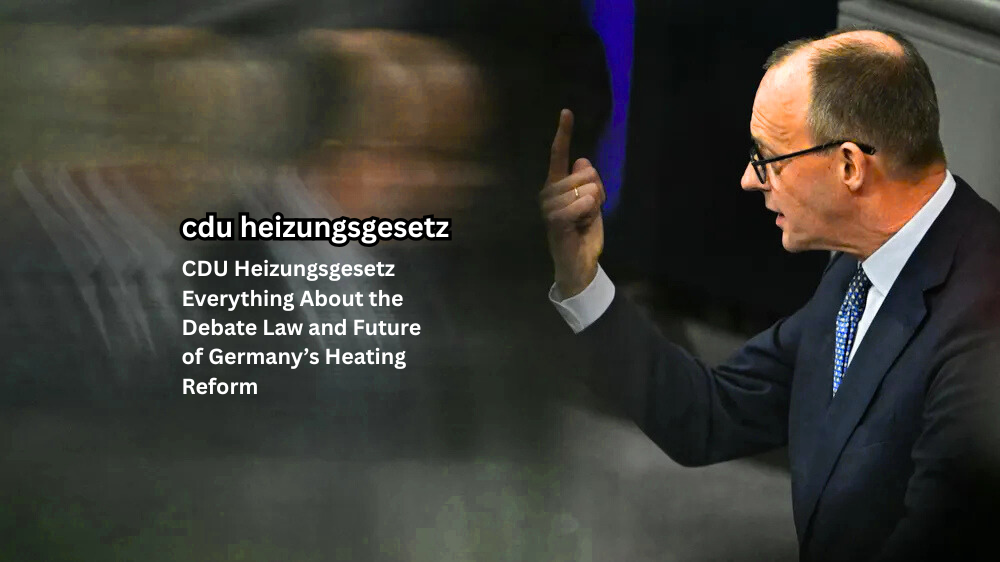
The CDU Heizungsgesetz topic has been one of the most debated political issues in Germany. It revolves around the Gebäudeenergiegesetz (GEG), which many people simply call the Heizungsgesetz or “Heating Law.” This law sets out new rules for how homes and buildings in Germany should be heated in the future, with a strong focus on renewable energy and climate protection. However, it has caused widespread discussion because of the costs, regulations, and the challenges many homeowners and municipalities face in following it
What the Heizungsgesetz Actually Is
The official name of the so-called CDU Heizungsgesetz is the Gebäudeenergiegesetz (GEG). It was introduced to help Germany reach its climate goals by reducing carbon emissions from buildings. Buildings in Germany are responsible for a significant share of greenhouse gas emissions, mainly due to fossil-fuel-based heating systems.
Under this law, new heating systems must be operated with at least 65% renewable energy. This means that when someone installs a new heating system, it should rely mainly on renewable sources such as solar power, geothermal energy, biomass, or heat pumps. For example, if you build a new home in a new construction area, your heating system cannot depend entirely on oil or natural gas.
The government introduced this law to reduce the use of fossil fuels and make heating more sustainable. However, the strict requirements have been a challenge for many property owners, especially those living in older buildings or rural areas where renewable infrastructure is limited.
The CDU’s Opposition to the Heizungsgesetz
The Christian Democratic Union (CDU) and its partner party, the CSU, have been very vocal about their criticism of the Heizungsgesetz. Their main argument is that the law was passed too quickly and without enough consideration for practical challenges faced by homeowners and local governments.
According to the CDU, the law focuses too heavily on one solution — heat pumps — and does not give equal opportunities to other technologies such as hydrogen, biogas, or hybrid heating systems. They believe that Germany should keep a “technology-open” approach, meaning that different energy sources should be allowed as long as they help reduce emissions.
The CDU also argues that the law creates uncertainty and financial stress for many people. Homeowners fear that their old heating systems may soon be banned or become too expensive to operate, while small municipalities are struggling to develop their local heating plans in time. The CDU believes that the government should provide more flexibility, financial support, and longer transition periods to make the change easier for everyone.
Overview Table: Key Facts About the CDU Heizungsgesetz
| Category | Details |
|---|---|
| Full Name | Gebäudeenergiegesetz (GEG) – commonly known as the Heizungsgesetz |
| Political Debate | The CDU opposes parts of the law and seeks a more flexible, technology-open reform |
| Main Goal | To make heating systems in Germany more climate-friendly by increasing renewable energy use |
| Renewable Energy Requirement | New systems must operate with at least 65% renewable energy |
| Applies To | Primarily new buildings and major heating replacements |
| Local Heat Planning Deadlines | Cities over 100,000 people: by June 2026; smaller towns: by June 2028 |
| Supported Technologies | Heat pumps, solar heating, biomass, district heating, hydrogen-ready systems |
| CDU’s Position | Wants more freedom for homeowners and better funding for different heating options |
| Financial Support | Government subsidies available for switching to renewable heating systems |
| Future Outlook | Reform discussions ongoing — major changes expected around 2026 |
What the Law Requires Right Now
As of 2024, the current version of the Heizungsgesetz remains in force. For new buildings in new development areas, the heating system must be based on at least 65% renewable energy. For existing buildings, the rules are less strict — homeowners can still use their existing oil or gas systems as long as they work properly. However, if a major renovation or replacement is needed, the system must meet renewable standards once the local heating plan is ready.
The deadlines for local heat planning are very important in this law. Cities with more than 100,000 residents must finish their heating plans by June 2026, while smaller municipalities have until June 2028. These plans will determine what kind of heating systems are allowed in each area, depending on local renewable energy availability.
For now, the government continues to support homeowners through subsidies and grants to install heat pumps and other renewable systems. However, these programs are complex and often not enough to cover the full costs, which is another reason for public frustration.

CDU’s Plan for Change
The CDU and CSU have both promised to reform or even repeal large parts of the current Heizungsgesetz. They want to replace it with a simpler, technology-neutral law that allows homeowners to choose their heating method as long as it meets climate targets.
One of their ideas is to promote hydrogen-ready heating systems that can run on natural gas for now but easily switch to hydrogen in the future. This would give people more flexibility while still supporting the transition to clean energy.
The CDU also wants to cut bureaucracy and make subsidies more accessible. They say that too many people are lost in paperwork and cannot get clear advice about what system they should install. Their proposed reform would simplify the rules and help both homeowners and local governments plan better.
Delays and Political Tensions
Although the CDU-led coalition and the SPD agree that the law needs improvement, reforms have been delayed several times. The reason is that every change must balance environmental goals with economic and social fairness.
Experts warn that delaying reforms creates confusion. Homeowners don’t know whether to install a heat pump now or wait for the new law. Installers and heating companies are also struggling to plan for the future because they don’t know which technologies will be supported.
According to several German newspapers, including Merkur and Tagesschau, the government has not yet published a full draft of the new reform. As a result, the original version of the Heizungsgesetz still applies, and major changes are not expected before 2026.
Impact on Homeowners and Municipalities
For homeowners, the current uncertainty means difficult decisions. If they need a new heating system, they must decide whether to follow the existing rules or wait for new ones. Those who act now may benefit from subsidies, but they also risk spending more if the law changes later.
Municipalities also face challenges. They are required to finish their local heat planning by 2026 or 2028, depending on size. This planning involves studying energy networks, renewable energy availability, and infrastructure development — all of which require time and funding.
The pressure is high because the heating transition affects millions of people. The cost of replacing systems, insulating homes, and building renewable infrastructure is massive, but failure to act could also increase Germany’s emissions and energy costs in the future.
The Numbers Behind the Law
The Heizungsgesetz includes clear targets and deadlines that show how ambitious the plan is.
- 65% renewable share in new heating systems.
- June 2026: Deadline for local heat plans in large cities.
- June 2028: Deadline for smaller municipalities.
- May 2026: Germany must meet EU requirements for building energy efficiency.
These numbers highlight how much pressure both the government and local communities face to meet climate goals while keeping housing affordable.
Key Controversies
There are several controversies surrounding the CDU Heizungsgesetz debate. Some experts warn that a full repeal of the law could violate EU climate commitments, while others say the current version is too strict and unrealistic.
Another major issue is regional fairness. In urban areas, heat pumps and district heating are easier to install, but in rural communities, these options can be very expensive. Critics argue that the law unfairly punishes those who live outside big cities.
Finally, the uncertainty about subsidies and future rules has caused a slowdown in the heating market. Many people are waiting to see what happens, which has led to fewer installations and more confusion.
What to Expect in the Future
Over the next few years, all eyes will be on how the CDU and the government reshape the law. Observers expect a more flexible framework that keeps the 65% renewable target but allows different technologies to reach it.
Homeowners should keep track of subsidy updates and local heat planning progress, since both will affect how and when they need to upgrade their systems. Energy companies, on the other hand, are pushing for clearer rules so they can invest in new heating technologies with confidence.
The success of this reform will depend on how well Germany balances climate protection, affordability, and freedom of choice. If the new version of the law achieves this balance, it could become a model for sustainable heating across Europe.
Final Thoughts
The CDU Heizungsgesetz debate reflects Germany’s struggle to combine climate goals with social and economic realities. While the intention behind the law — reducing emissions and promoting clean energy — is widely supported, its implementation has been complicated and divisive.
The CDU continues to push for a reform that supports both innovation and fairness, ensuring that the transition to green heating does not leave anyone behind. Until new reforms are officially passed, homeowners and municipalities must continue navigating the existing law, adapting as the political and environmental landscape evolves.
FAQs
Q: What is the CDU Heizungsgesetz?
A: The CDU Heizungsgesetz is a heating law in Germany focused on renewable energy use in buildings.
Q: What does the CDU Heizungsgesetz require?
A: It requires new heating systems to run on 65% renewable energy.
Q: Why does the CDU oppose the Heizungsgesetz?
A: The CDU says the Heizungsgesetz is too costly and limits technology choices.
Q: When will CDU Heizungsgesetz reforms happen?
A: Reforms to the CDU Heizungsgesetz are expected around 2026.
Q: Does the CDU Heizungsgesetz affect old heaters?
A: No, the CDU Heizungsgesetz mainly affects new systems, not existing ones.